“You’re lucky—you were born that way.”
“At least you lost your limb when you were young.”
Within the limb loss community, these statements can overlook a significant part of someone’s life. Adapting physically is only one part of living with a limb difference or limb loss – and this applies to people of all ages. The emotional and social challenges deserve equal consideration.
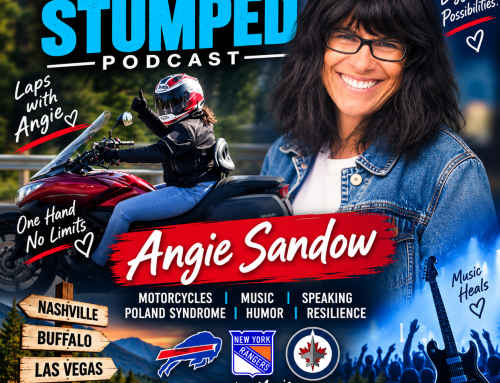
In this solo episode of We’re Not Stumped, I share my perspective as someone born without a right hand and challenge the assumption that people born with limb differences—or who experienced amputation as children—automatically have it easier. and I share a recent experience that shapes this conversation.
Through my podcast and community work, I’ve met people whose experiences include bullying, barriers to employment, difficulties forming relationships, and years of depression. While those experiences don’t all describe my own journey, they deserve to be heard and acknowledged.
Acquiring a disability later in life brings its own challenges, including grieving what someone has lost. Recognizing those challenges doesn’t require us to minimize someone else’s.
Each journey carries challenges that may not be visible from the outside. We build a stronger community when we listen to those experiences without deciding who has it easier.
Before we tell someone they’re lucky, let’s ask what their experience has actually been.
Listen on Apple Podcasts
Watch on YouTube
Listen on Spotify

What do you do when life is going perfectly—until it’s not? In this powerful episode of We’re Not Stumped, host Mike Bolland talks with Kijuan Amey—a U.S. Air Force veteran, entrepreneur, and traumatic brain injury survivor whose life changed in an instant. At just 25, Kijuan was thriving: one year from earning his degree, running his own business (Kiwi Enterprise LLC), and proudly serving his country. Then, a sudden motorcycle accident nearly took it all away. But instead of asking, “Why me?”, Kijuan chose a different question: “What now?” Through faith, grit, and a desire to help others, he turned unimaginable trauma into purpose—and a message of hope.

In this episode, host Mike Bolland shares the inspiring story of Carter Henning, a high school freshman from Calamus-Wheatland in Iowa who returned to lead his varsity golf team just two months after losing his leg in a snowmobile accident. Carter’s determination and passion for the game showcase what’s possible with resilience and heart. Mike also highlights the Dallas Amputee Network (DAN), a nonprofit offering vital support and peer mentorship to amputees and their families across North Texas. Founded by Ellen Winchell in 2002, DAN empowers individuals through monthly meetings, the Certified Peer Visitor program, and a strong community of encouragement.

In this episode, we sit down with Vanessa Abraham, a certified Speech-Language Pathologist whose life took an unexpected turn when she became the patient. After a sudden illness left her paralyzed and unable to speak, Vanessa faced the daunting task of reclaiming her voice and identity. Vanessa shares her harrowing experience of battling Post-Intensive Care Syndrome (PICS), the emotional toll of being unable to communicate, and her path to recovery. Her story is not just one of survival but of transformation, leading her to become an advocate for ICU survivors and author of the memoir Speechless: How a Speech Therapist Lost Her Ability to Speak and Her Silent Struggle to Reclaim Her Voice and Life.